Tutorial & Setup for Guit-Arco
Setup and Playing Guide
This page explains how to set up and play the Guit-Arco.
Basic Setup
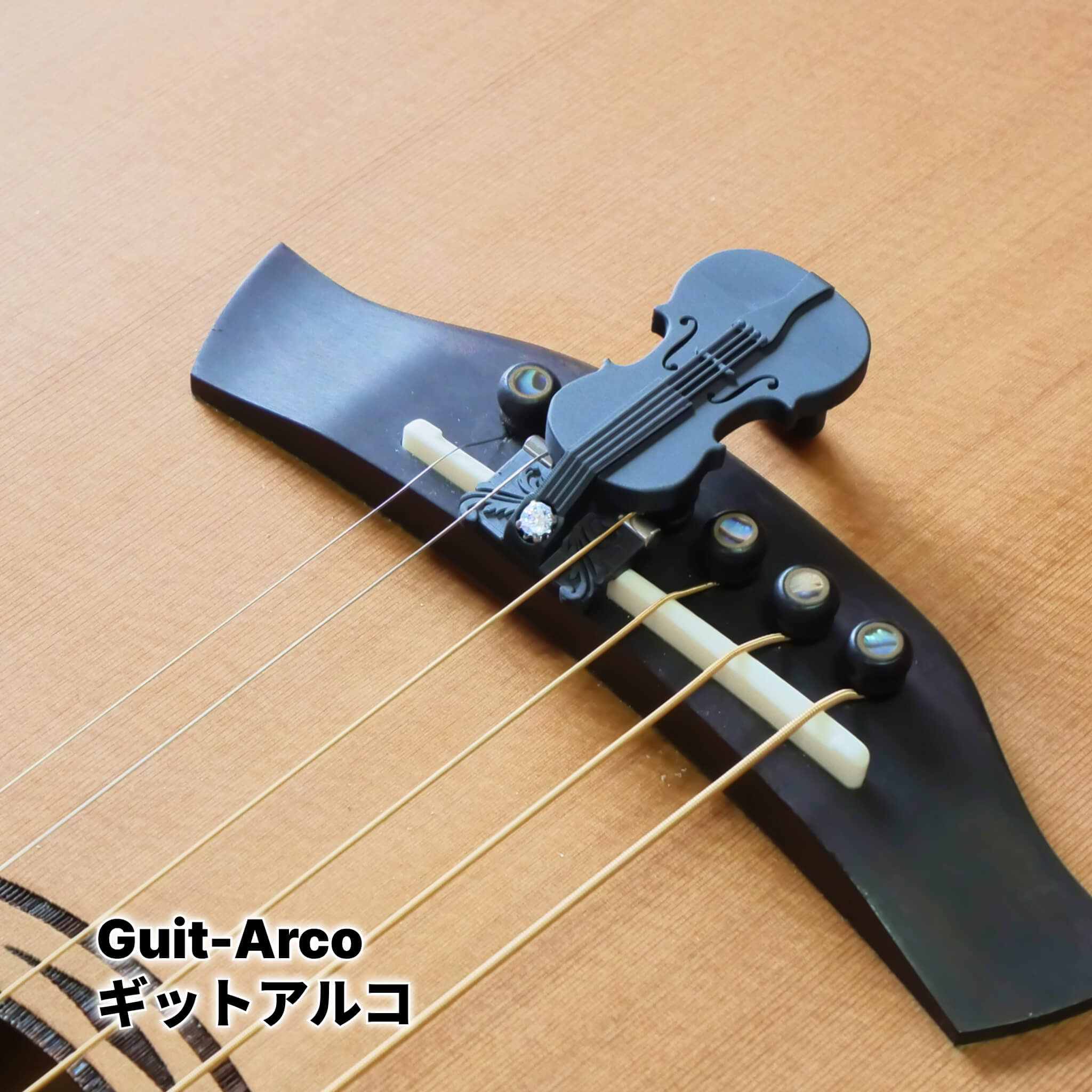
In this example, we’ll demonstrate installation on the 1st and 2nd strings.

2. Place the selected two strings onto the left and right metal bars.
3. Hook the Guit-Arco onto the bridge saddle to secure it in place.
Installation is now complete.
For tuning, set: 2nd string to A / 1st string to D.
How to Use the Pinless Anchor
Next, let’s look at the included Pinless Anchor.
On some guitars—especially on the lower strings—the distance between the saddle and bridge pin may be too short.
In such cases, limited physical space or a steep string angle may make installation difficult.
This is where the Pinless Anchor becomes useful.

2. Make sure the ball end is fully seated inside the anchor.
3. Feed the string through the guitar body from the inside.
This allows you to string the guitar without a bridge pin, making Guit-Arco installation easier.
Height and Angle Adjustment
Next, let’s discuss another included accessory: the height adjusters.
Depending on your guitar’s setup, you may wish to adjust the height or angle of the Guit-Arco.


Two types are included: 0.5 mm / 1.0 mm.
You can fine-tune the left and right sides independently in 0.5 mm increments.
How to Hold the Bow
There is no single correct way to hold the bow.
However, your fingers should remain relaxed rather than rigid, allowing flexible control.
Here is one recommended grip:

2. Place your thumb and middle finger in the frog’s indentation, gently pinching it.
3. Rest your index finger underneath to support the bow.
4. Allow the screw at the end of the bow to naturally touch the soft base of your thumb.
Make sure you can move the bow freely with this grip.
Your index finger and thumb base should touch lightly—avoid excessive pressure.
If you are not yet accustomed to handling a bow, the metal part near the frog may accidentally scratch your guitar body.
To protect your instrument, apply the included felt sticker to the metal parts of the bow.

Bow Control
Start by bowing both strings together to become comfortable with the motion.
Move the bow perpendicular to the strings, keeping it straight rather than angled.


For finer adjustments, you may also use thin materials such as aluminum foil as shims.
String Selection and Tuning Variations
2nd (A) + 3rd (E) = Viola-like warm tone
3rd (F) + 4th (C) = Cello-like rich tone
5th (G) + 6th (C) = Double bass-like low register

String Choices and Tips
Coated strings such as Elixir are not recommended, as they tend to produce weaker bow response.
Among regular guitar strings, wound strings may initially feel harder to activate with the bow.
Applying rosin not only to the bow but also lightly to the wound strings can improve response.
You may also enjoy experimenting with cello strings for expanded tonal possibilities:
- Cello 2nd string (D) → Use as guitar 4th string
- Cello 3rd string (G) → Use as guitar 5th string
- Cello 4th string (C) → Use as guitar 6th string
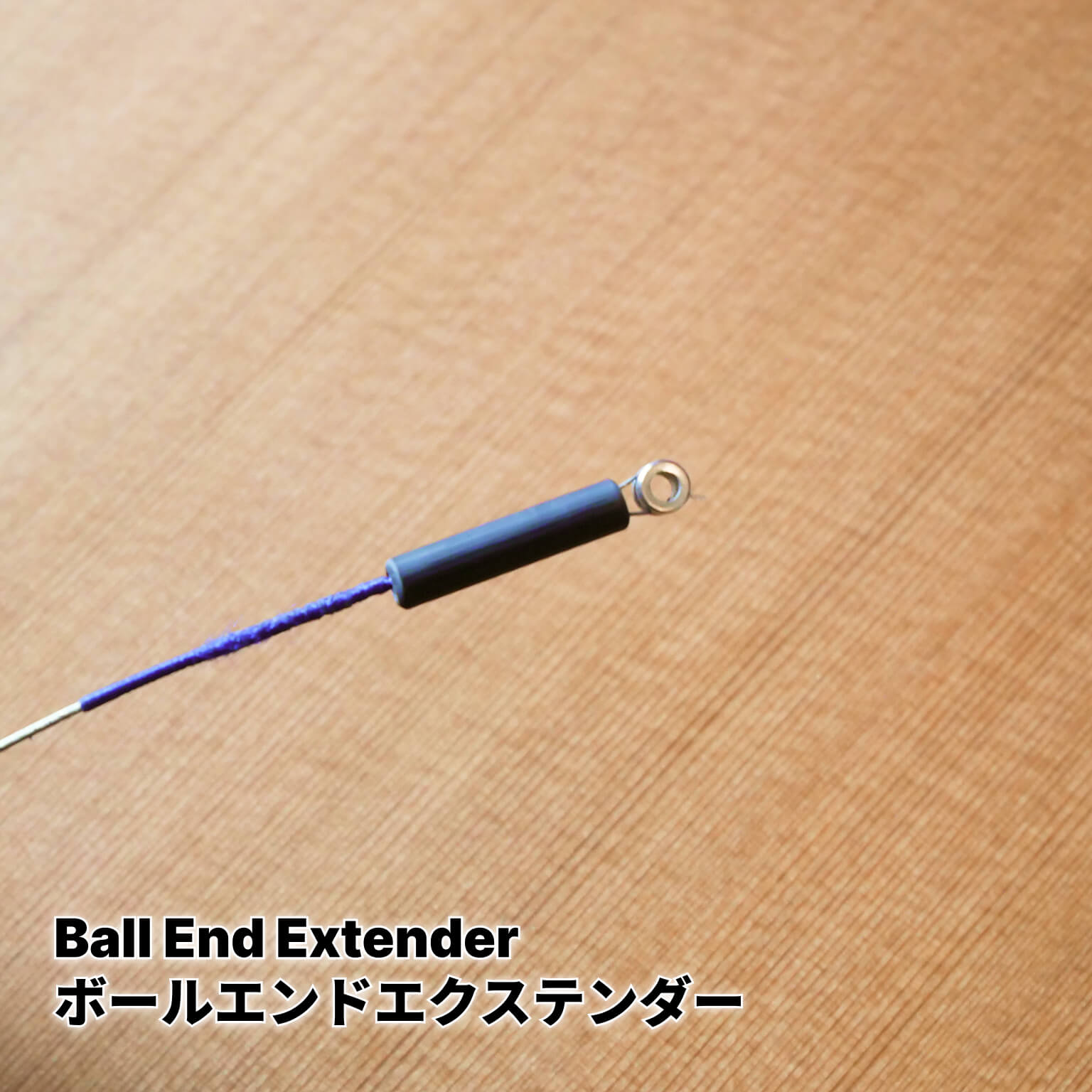
However, many cello strings have long silk windings. If installed as-is, this may affect pitch stability or sustain.

In such cases, please use the optional Ball End Extender (sold separately).
Also note that cello 1st strings have a thin core and may break easily near the tuning peg.
If concerned, consider utilizing the silk portion or inserting cushioning material for protection.
FAQ
Which bow and rosin should I use?
Please use standard violin bows and rosin.
You may also use a viola or cello bow if you prefer, but keep in mind that they are designed to be heavier than violin bows.
If you are just getting started, we recommend trying a lightweight violin bow first.
Where on the strings should I bow?
If you bow too close to the bridge saddle, the sound may become scratchy or overly harsh.
If you bow too far from the bridge saddle, changing strings becomes more difficult.
As a starting point, try bowing a few centimeters away from the bridge saddle and adjust to find the position that works best for you.
I can’t get a good sound.
First, make sure you are using enough rosin on the bow.
If wound strings are difficult to sound, try applying a small amount of rosin directly to the string as well.
Using flatwound strings or cello strings instead of typical roundwound guitar strings can also help produce a clearer tone.
If nylon plain strings are difficult to sound, lightly roughening the string surface may improve responsiveness.
Other Items
![Sitar Express® for Acoustic Guitar [Current Model]](http://logicwave.jp/cdn/shop/files/sitar_2024_01.jpg?v=1705141659&width=1550)